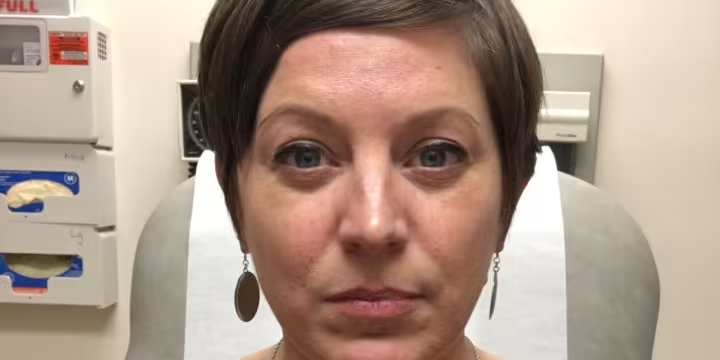
When Laura Behnke went in for an embryo transfer at 41, she was excited and terrified. She had already gone through four rounds of in-vitro fertilization and had only one healthy embryo.
Behnke’s husband, Marc, has a rare genetic condition which could be fatal if passed to their child. "We needed to go through IVF so that we could have the embryos tested for his condition," Behnke, now 46, of San Francisco, tells TODAY.com.
Behnke, a former sports anchor, had no health issues herself. “I’m active, I eat well. I've always considered myself to be a very healthy person,” she says.
Starting IVF at 40 was a struggle, Behnke says, but in January 2021, the couple got their "miracle embryo" and were ready for implantation.
"At that point, I was 100% focused on getting pregnant and making sure that nothing would get in the way of this potential baby," she says.
So when Behnke noticed an odd symptom after using the bathroom the week before her transfer, she brushed it off.

Rectal Bleeding Was First Cancer Symptom
“There was blood on the toilet paper and some blood in the bowl," says Behnke. She had no pain or bowel habit changes.
"I'd never had that before. Occasionally, you have a little bit of blood, but this was different."
Behnke was alarmed, but distracted. "I was so focused on the fact that we had a transfer in a couple of days (that) I did not want to have to pause to try and figure out what was going on. I had blinders on."
So, she chalked it up to IVF stress. "Every part of my life had been straining, and certainly I was straining in the bathroom, so I must've aggravated something," she recalls thinking.
The embryo transfer was successful and the bleeding stopped. “I was so fortunate to become pregnant, I didn’t think about the blood anymore," she says.
"I told myself it’s just hemorrhoids."
During Behnke's second trimester, the rectal bleeding started again. "At this point, I was reading everything about being pregnant, and it's right around the second trimester they warn you that hemorrhoids start to come up," she says.
Hemorrhoids are swollen veins inside the rectum or on the anus, which can cause bleeding during bowel movements, per the Cleveland Clinic. They're very common during pregnancy and aren't always visible.
"I told myself, 'It's just hemorrhoids. Relax.'"
Behnke mentioned the bleeding to her obstetrician, who agreed. "I didn't make it a big deal, she didn't ask questions ... I kind of self-diagnosed," she says.
Then, in her third trimester, Behnke developed an obvious external hemorrhoid. Unlike her earlier rectal bleeding episodes, this was painful, itchy and uncomfortable.
"Still in my head, I wasn't connecting the dots that I had never felt that way before when I was bleeding," she says.

In December 2021, Behnke delivered a healthy baby girl, Mari. The bleeding stopped. "I was like, 'OK, that was it. Now this external hemorrhoid is going to fix itself.' Wishful thinking."
While Behnke was in a "newborn haze," the bleeding returned. Her OB-GYN told her she'd need surgery remove her external hemorrhoid, which Behnke decided to put off.
Six months later, she saw her GP, who referred her to a colorectal surgeon for the removal.
Stage 3b Colorectal Cancer
The surgeon knew "almost immediately" it wasn't just hemorrhoids, Behnke says. “It turns out that hemorrhoid bleeding tends to be more like droplets of blood ... I was not having that, I was having bloody mucus."
In July 2022, Behnke had a colonoscopy, which revealed a mass where her rectum met her colon.
A biopsy and imaging confirmed Behnke had Stage 3b colorectal cancer. "It had broken through the rectal wall and was in some nearby lymph nodes, but thankfully, it was not metastatic and had not advanced to other organs," she explains.
Pregnancy Can Mask Cancer Symptoms
Initially, Behnke wondered how her cancer was missed during IVF and a pregnancy. "I had more blood drawn in those two years than I had had in my entire life combined," she says.
However, she now knows that routine blood tests don't always pick up colorectal cancer, especially in the early stages.
Colorectal cancer is known as a "silent killer" because it often presents with few symptoms until the cancer has metastasized to other organs, making it difficult to treat, TODAY.com reported previously.
“I was growing a human right by where I had cancer. ... It's mind-blowing that I was as sick as I was, and I didn’t feel sick.”
Behnke suspects her pregnancy may have masked other symptoms aside from bleeding, like fatigue and weight loss.

"I was tired, but I also had newborn at the time. And I was losing weight, but I was postpartum so my body was adjusting. And I had an urgency to go to the bathroom, but I had that since being pregnant," she says.
“I still don’t know what symptoms were caused by my pregnancy and what was caused by the cancer, which is scary."
Radiation, Chemotherapy and Ileostomy
Behnke started treatment immediately. "It was five weeks of daily radiation, then five cycles of chemotherapy over 15 weeks."
In addition to "grueling" chemotherapy side effects, she had hot flashes and mood swings because radiation sent her into early menopause.
After chemotherapy, Behnke had several surgeries to remove the affected tissue and reconstruct her digestive tract.
In February 2023, she had a lower anterior resection. "They removed the top half of my rectum and the bottom section of my colon and rejoined the two together. After, I had 17 lymph nodes removed," she says.
In order to let the new connection heal, Behnke had a temporary ileostomy. This involves creating an opening in the abdomen and connecting it to the small intestine, which diverts waste into an ileostomy bag, per the Cleveland Clinic.
"I had the ileostomy bag for seven weeks, and then I had the reversal," says Behnke. After treatment, her scans came back clear with no evidence of disease.
"My daughter and I were both in diapers."
Behnke says the period after her ileostomy reversal was the "hardest part" of her cancer journey. “Nothing could've prepared me for having basically no control over my bowels after. My daughter and I were both in diapers at the same time."
She struggled with diarrhea and fatigue as her digestive tract relearned how to function with a vital section missing.
Almost three years later, Behnke has made significant progress. "I am still in the bathroom a lot more than I would like to be, but I'm no longer afraid to leave the house."
Behnke credits pelvic floor therapy, strength training and fiber.
“My day revolves around making sure I get enough fiber. I eat fruits and veggies with every single meal ... and I take fiber supplements," she says.
Behnke is in remission but still gets routine scans and colonoscopies. As of her last scan in August 2025, she has no evidence of disease.

Colorectal Cancer Rising in Young People
Colorectal cancers are skyrocketing among young adults in the U.S., according to the Cancer Research Institute.
Colonoscopies are the best early screening tool, followed by stool-based tests, but these aren’t recommended until age 45 for average-risk individuals, per the American Cancer Society. Behnke was only 42 and had no risk factors.
"I knew nothing about colorectal cancer," says Behnke.
In hindsight, she wishes she brought up the bleeding sooner and pushed to rule out other causes. “Anytime you are bleeding where you shouldn’t be, that is something a doctor needs to know about,” she says.

She also felt that her doctors didn't initially ask her enough questions about the nature of her bleeding and dismissed her because she was pregnant. “I think there’s a large gap in the medical world when it comes to colorectal health."
Today, Behnke advocates for early detection and access to colorectal screenings. She encourages young people to speak up about bowel changes and not to feel ashamed.
"I never though I would be talking so much about poop, but here we are, and I will not stop talking about it."