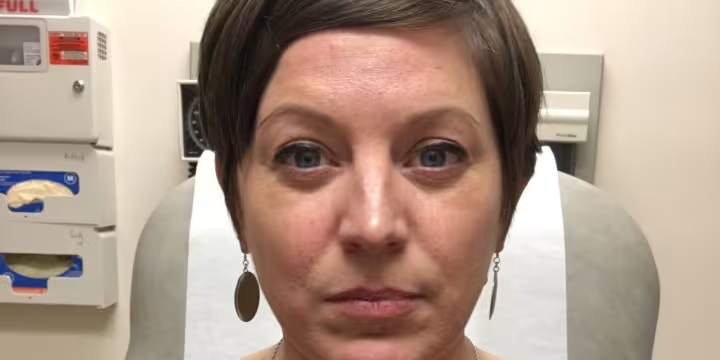
Hayley Dietz was 32 when she began noticing strange symptoms — most frighteningly what she calls “strange bleeding.”
The young mom felt pain during sex and saw blood afterwards. Her periods seemed heavier. There was a dull pain in her hips when she moved, almost like arthritis.
Dietz thought the problems were related to an intrauterine device (IUD) that was placed after she gave birth to her son. But when she went to her gynecologist to have the contraceptive removed, the true diagnosis emerged.
Dietz had an almost 3-inch tumor on her cervix and was ultimately diagnosed with Stage 3b cervical cancer.
“It was really scary,” Dietz, who lives in Middlefield, Ohio, tells TODAY.com. “(I thought), I don't know how I can do this. I'm going to miss a lot of time with my kids.”
Incidence of cervical cancer has been increasing in women in their 30s and early 40s, even as it has plummeted for women in their 20s, according to the American Cancer Society.
For Dietz, who is now 42, it’s been an almost decade-long ordeal after the disease seemed to disappear with treatment, but then returned.

After enduring the cancer twice, she’s now been in remission for a year-and-a-half and credits an unusual source of comfort that kept her going: bouncy, energetic pet goats — a gift from her husband.
“They're living beings. They need me to take care of them. So it was like another reason to get out of bed every day,” Dietz says.
“Lots of patients have things that inspire them and give them the will to carry on,” Dr. Robert DeBernardo, her gynecologic surgical oncologist at the Cleveland Clinic, tells TODAY.com.
“Many of them have pets, dogs, cats, that really are maybe like the light — sort of that guiding light that makes them keep going.”
Cancer Grows Silently
Cervical cancer is highly preventable thanks to the HPV vaccine — which protects people from high-risk strains of the human papillomavirus, the most common cause of the cancer — and routine screening that can find the cancer early, including the HPV test and the Pap smear.
Women can now opt for a self-swab HPV test.
Dietz wasn’t vaccinated, but she’d been getting regular screenings — until she had her son in 2010, when the appointments “just kind of fell off,” she says. Cervical cancer was not on her radar at all.
Pre-cancer, which the Pap smear is designed to detect, is “100% asymptomatic,” DeBernardo says. It grows slowly and silently.
“That's why seeing your gynecologist every year should still be the thing. Period, end of story,” he notes. “They'll determine whether or not you need a Pap test, and you'll never be caught in the situation that Hayley was in with development of a cancer.”
Symptoms of advanced cervical cancer include abnormal vaginal bleeding, pain and discharge, DeBernardo says.
If lymph nodes are involved, they can grow and cause pressure on nerves, leading to hip pain, which Dietz experienced, or back pain, he adds.
Tumor 'Obliterated,' But Cancer Comes Back
When Dietz was first diagnosed in 2015, the tumor was too big to be removed surgically.
But doctors removed 15 lymph nodes in her abdomen. Eight were positive for the cancer cells.

Dietz underwent six weeks of concurrent chemo and radiation that she describes as “hell.” She lost 30 pounds due to nausea and exhaustion, but the treatment worked. There was no evidence of the tumor afterward — it was “essentially obliterated,” she says.
The mom continued to have clean scans. But three years later, she suddenly started feeling very tired. Then one of her coworkers noticed a large lump in her neck.
A needle biopsy revealed her cervical cancer had returned, but this time, it had spread to the lymph nodes in Dietz’s chest, armpit and neck.
“We sterilized the disease that was in her pelvis and her abdomen. So the next place that it would go would be into the chest,” DeBernardo says, explaining there must have been some undetectable cancer cells left after treatment that then traveled to the lymph nodes in her chest.
Immunotherapy can be “super effective” in these cases, but Dietz wasn't able to tolerate it, DeBernardo says. So for the next five years, Dietz had to try different chemotherapies and drugs to treat the cancer.
Goat Therapy
During the ordeal, Dietz had been researching goats. She and her family live on six acres of land in a rural area of Ohio and already had a menagerie of pets.

“I had wanted goats for quite a while,” she says. “They just seemed like they brought a lot of happiness to people.”
So her husband surprised her with two goats that then grew into a flock of seven.
“They bring me so much happiness. It's absolutely amazing,” Dietz says.
“Even though I was so sick and exhausted, I had to get up, I had to give them hay, I had to clean the barns. It gave a little bit more meaning and purpose to my life every day, and I absolutely love it.”
DeBernardo saw the difference, too.
“She just needed that impetus to keep fighting,” he notes. “I think for Hayley, getting the goats was basically a way of gaining that control in her life back.”
The doctor found a cancer treatment that worked, and her last dose of chemo was in March 2024. She's been disease-free since then.
But her life has changed. Physically and emotionally, it's been tough, Dietz says. She gets tired quickly and can only work part time. The mom takes antidepressants and has a team of doctors, psychologists and therapists.
Dietz urges women to get Pap smears and other health screenings, and to pay attention to symptoms.
“It's so important that women hear the message that they should be screened, this is not the end of the world — we have good treatments,” DeBernardo adds.